Buggsy Master Ant Treatment Guide
Complete treatment reference for every ant species in the Buggsy library. Written 2026-07-07 from industry-standard practice + current product research. Use this as the source of truth for pest-page instructions, product mapping, PDF guides, and video scripts.
Species covered (all 10 in library): Odorous House Ant, Argentine Ant, Little Black Ant, Pavement Ant, Acrobat Ant, Crazy Ant, Thief Ant, Pharaoh Ant, Carpenter Ant, Fire Ant.
Part 1: The rules that apply to every ant job
These principles are why most DIY ant control fails, and they apply to every species below.
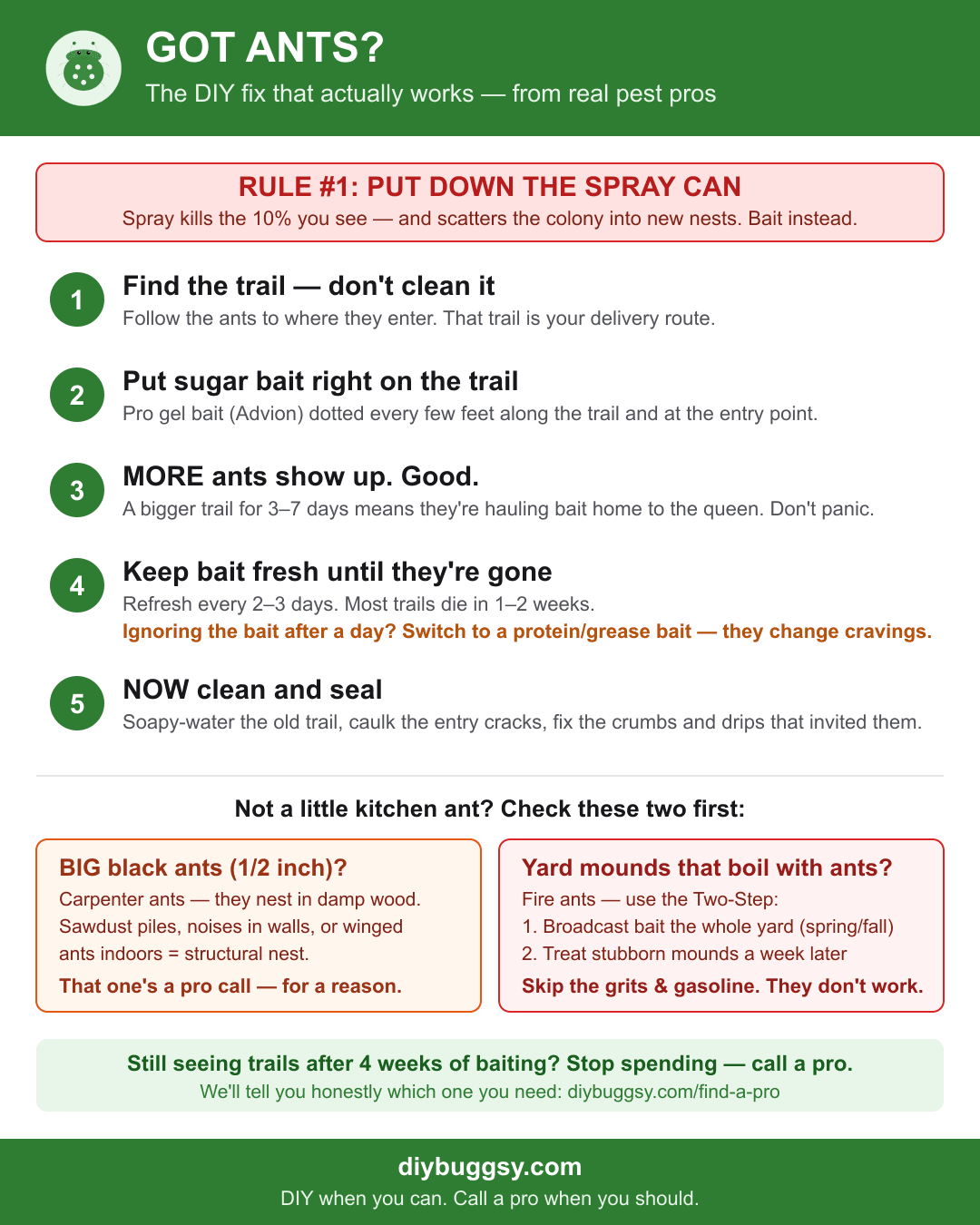
- The ants you see are ~10% of the colony. Workers you can spray are expendable; the queen(s) and brood stay protected in the nest. Kill on contact and the colony replaces the workers in days.
- Baits beat sprays for ants, almost always. A slow-acting bait gets carried back and fed to the queen and brood (trophallaxis). University IPM programs call baiting "the only type of insecticide recommended in most situations" for ants.
- Never spray where you bait. Repellent sprays (most store-bought aerosols, and pyrethroids like bifenthrin/deltamethrin/lambda- cyhalothrin) contaminate the trail and drive ants away from your bait — or worse, split the colony (see budding, below).
- Match the bait to the appetite. Ant food preference swings between sugar (carbohydrate) and protein/grease, by species and by season (protein demand spikes when colonies are rearing brood, typically spring). If a bait is ignored within 24 hours, switch bait types, not brands.
- Budding species need special care. Odorous house, Argentine, pharaoh, and crazy ants have multi-queen colonies that split into several new colonies when stressed by repellent sprays. Spraying these species indoors is how a one-kitchen problem becomes a whole-house problem.
- Non-repellents are the professional's spray. When a liquid is called for (perimeters, carpenter ants), pros use non-repellent actives — fipronil (Taurus SC/Termidor), dinotefuran (Alpine WSG) — that ants can't detect, walk through, and transfer to nestmates.
- Sanitation is half the treatment. Wipe trails with soapy water (removes pheromone), fix moisture, trim vegetation off the house, seal obvious entry gaps — but do the sealing after baiting succeeds, not before.
- Always read and follow the label. The label is the law: it defines where a product may legally be applied (indoor/outdoor, food areas, turf), rates, PPE, and re-entry for kids/pets.
Part 2: Species → treatment group
| Species | Common names people use | Group | DIY level |
|---|---|---|---|
| Odorous House Ant | piss ant, sugar ant, stink ant | A — Sugar/trail ants | Easy DIY |
| Argentine Ant | sugar ant | A — Sugar/trail ants | Easy DIY |
| Little Black Ant | sugar ant | A — Sugar/trail ants | Easy DIY |
| Pavement Ant | sidewalk ant | A — Sugar/trail ants | Easy DIY |
| Acrobat Ant | heart-butt ant | A — Sugar/trail ants (+moisture check) | Easy DIY |
| Crazy Ant | crazy ant | A — Sugar/trail ants (erratic, multi-bait) | Easy DIY |
| Thief Ant | grease ant, piss ant (regional) | B — Grease/protein ants | Easy DIY |
| Pharaoh Ant | sugar ant (often misidentified) | C — Bait-ONLY budding ants | Possible DIY |
| Carpenter Ant | big black ant, wood ant | D — Structural ants | Pro Recommended |
| Fire Ant | red ant | E — Mound/turf ants | Easy–Possible DIY |
Note on "piss ants": in most of the country this means the odorous house ant (crushed workers smell like rotten coconut/blue cheese); in some regions it refers to thief ants. Both are covered below — they take different baits, which is exactly why misidentification wastes money.
Part 3: Group A — Sugar/trail ants
Odorous house, Argentine, little black, pavement, acrobat, crazy ants. Small ants trailing to kitchens, baths, and pet bowls. Multi-queen (odorous house, Argentine, crazy) or single-queen (little black, pavement, acrobat) — the protocol is the same; multi-queen species just take longer.
Indoor protocol (2–3 weeks to full elimination)
-
Follow the trail. Find where ants enter (window frame, plumbing penetration, baseboard gap) and what they're feeding on. Don't clean the trail yet — you're going to use it.
-
Place sugar bait directly on the trail. Advion Ant Gel in pea-size dots on wax paper or in bait stations, every 2–3 ft along the trail and at the entry point. For heavy trails, add Niban granular bait at the exterior entry side for mass feeding.
-
Let them feast. The trail will get heavier for 3–7 days. This is the treatment working — foragers are hauling bait to the queen. Do not spray, do not wipe the trail, do not panic.
-
Refresh bait every 2–3 days until feeding stops. Dried gel is ignored.
-
If bait is ignored in 24 hours: they're in a protein mood. Switch to Niban granular bait (protein/grease-accepted) or put out both.
-
After the trail dies: now clean with soapy water, caulk the entry points, and fix what attracted them (crumbs, pet food left out, dripping trap).
-
Crazy ant note: they trail erratically and feed unpredictably — run sugar AND protein bait simultaneously from day one, use more placements, and expect a longer timeline.
-
Acrobat ant note: indoor acrobat ants almost always mean a moisture-damaged wood void or old carpenter-ant/termite gallery. Bait as above, but find and fix the moisture or they will return.
Outdoor/perimeter protocol (do this the same week)
- Non-repellent perimeter spray: fipronil (Taurus SC) or dinotefuran (Alpine WSG) banded 1 ft up / 1 ft out around the foundation, plus trailing routes. Ants walk through it, carry it home, and transfer it — colony collapse in 1–2 weeks. This is the single highest-impact outdoor step. (Fipronil labels typically allow 2 treatments per year — timing: late spring + late summer.)
- Granular bait the yard-side pressure: Niban (boric acid) or a perimeter granular bait scattered in mulch beds, along walkways (pavement ants nest under slabs), and around nest sites.
- Do NOT band the foundation with repellent granules or sprays in the same zones where you're baiting or using non-repellents. Bifenthrin granules (Bifen L/P) are fine as a standalone barrier strategy for general pests, but they undercut an active ant baiting program — choose one lane per season.
- Habitat: trim shrubs/branches touching the house (ant highways), pull mulch back 6" from the foundation, fix gutter leaks.
Success looks like: heavy feeding days 1–5, taper by day 10, gone by day 14–21. Call it failed (and call a pro) if trails persist past 4 weeks of correct baiting — likely a parent colony issue or multiple colonies.
Part 4: Group B — Grease/protein ants (Thief Ant)
Tiny (1.5mm) yellowish ants, often mistaken for pharaoh ants. They nest close to other ant colonies and steal brood; indoors they hit grease, meats, cheese, and pet food — sugar baits usually fail.
- Confirm ID first (thief vs pharaoh matters — see Group C). Thief ants have a 2-segmented club antenna and are even smaller than pharaohs.
- Bait with protein/grease baits: Niban granular bait, or a smear of gel bait mixed into a dab of peanut butter as a monitoring trick.
- Place at trail sites, under appliances, along cabinet hinges — they travel wiring and plumbing lines.
- Same rules: no spraying, refresh every 2 days, expect 2–3 weeks.
- Perimeter non-repellent treatment as in Group A if trails come from outside.
Part 5: Group C — Pharaoh Ants (bait ONLY — this is the one you can genuinely make worse)
Small yellow/amber ants, indoor colonies with many queens, famous for infesting walls, outlets, and (in commercial settings) hospitals. The defining rule:
NEVER spray pharaoh ants. Not aerosol, not perimeter, not "just this one trail." Spraying fractures the colony into multiple new colonies (budding) and turns one nest into ten.
Protocol (4–8 weeks — patience is the treatment)
- Pre-bait/monitor: dabs of honey and peanut butter on index cards to map trails and read the current food preference.
- Bait heavily with what won: sugar-side (Advion Ant Gel) and/or protein-side (Niban granular). Place every 5–10 ft along every active trail, window sills, outlets (bait stations near, never liquids into, electrical), bathroom and kitchen plumbing lines.
- Use slow actives only (borate, indoxacarb, fipronil baits, hydramethylnon, or an IGR like methoprene/pyriproxyfen granular bait added alongside). Fast-kill = dead foragers = fed nobody.
- Maintain continuous bait supply — an empty station teaches them to forage elsewhere. Refresh every 2–3 days for the full run.
- Re-inspect at 4 weeks. Shrinking trails = stay the course. No progress or trails in multiple rooms/floors = call a pro — whole-structure pharaoh work is legitimately hard, and per Buggsy's honesty rule this is a "Possible DIY" that upgrades to pro quickly.
Part 6: Group D — Carpenter Ants (Pro Recommended — here's the honest version)
Large (6–13mm) black or red/black ants. They don't eat wood — they excavate moisture-softened wood to nest in, which is why they signal (and cause) structural problems. Buggsy's rating: Pro Recommended. Minor/exterior cases are DIY-able; anything suggesting an interior parent nest deserves a professional inspection.
Why this one's different
- The colony structure is a parent colony (often outdoors — stump, woodpile, dead limb) + satellite colonies (often in your wall voids). Killing a satellite without the parent = re-infestation.
- Winged swarmers indoors, sawdust piles (frass) from ceilings/window frames, or rustling in walls at night = established interior nest = call a pro. That's also potentially a wood-damage insurance/repair conversation, not just a bug problem.
DIY protocol for minor/exterior activity
- Night inspection (they forage after dark): follow trails between 9pm–midnight with a red-filtered flashlight. Find where they enter the structure and, ideally, where the trail comes from.
- Bait the trails: carpenter ants swing between sugar and protein — offer Advion gel AND a protein granular bait; refresh constantly. Slow-acting bait stations are the highest-percentage colony kill.
- Non-repellent perimeter + trail treatment: fipronil (Taurus SC) or dinotefuran (Alpine WSG) along the foundation, around entry points, and on the trunk-lines of trees carrying trails.
- Dust accessible voids and galleries: D-Fense Dust (deltamethrin) puffed into weep holes, hollow doors, window-frame voids where activity is confirmed. (Dust is the exception to the no-pyrethroid guidance — inside a sealed void it can't contaminate bait trails.)
- Kill the conditions: replace wet/rotted wood, fix the leak, restack firewood away from the house, cut branches touching the roof.
- Escalate to a pro if: frass keeps appearing, you hear activity in walls, swarmers emerge indoors, or activity survives 3–4 weeks of the above. Structural nests often need drill-and-dust or foam injection — pro equipment, pro judgment.
Part 7: Group E — Fire Ants (the Two-Step Method)
Aggressive red/brown mound-builders; stings are medically significant. Yard/turf problem rather than an in-house problem. The university- extension standard is the Two-Step Method:
Step 1 — Broadcast bait the whole yard (the colony killer)
- Product: Advion Fire Ant Bait (indoxacarb) — the professional broadcast bait; colonies collapse in roughly 24–72 hours.
- Broadcast at label rate (typically ~1–1.5 lb/acre — a little goes a long way) with a hand spreader, when ants are actively foraging (ground temp 70–90°F, no rain for 24–48h, fresh bait from a sealed container — rancid bait is ignored).
- Timing: late April–mid June and late August–mid October. One to two broadcasts a year keeps most yards near zero.
Step 2 — Nuke the problem mounds (the fast knockdown)
- 7–10 days after broadcasting, individually treat surviving/high-risk mounds (near play areas, doors, AC units): apply Advion Fire Ant Bait around (not on top of) the mound per label, and use Bifen L/P granules for lasting yard pressure.
- Don't kick or disturb the mound first — the colony evacuates the queen deeper. Treat calm mounds, from the outside in.
What NOT to do
- Grits, gasoline, boiling water, club soda: folklore. At best they move the mound; at worst (gasoline) they poison your yard and are illegal applications.
- Mound-only treating without the broadcast step = whack-a-mole; new queens re-found colonies constantly in fire ant country.
Pro triggers: stinging incidents involving allergic family members, mounds against the foundation/electrical boxes, or acreage-scale pressure.
Part 8: Product list (professional grade only — the Buggsy rule)
| Product | Active | Role in this guide |
|---|---|---|
| Syngenta Advion Ant Gel | indoxacarb | Primary sugar bait — Groups A, C, D |
| Nisus Niban Granular | boric acid | Protein/grease + outdoor/attic granular bait — A, B, C |
| Taurus SC | fipronil (non-repellent) | Perimeter backbone — Groups A and D |
| Alpine WSG | dinotefuran (non-repellent) | Indoor-safe non-repellent spray — A, D |
| Syngenta Advion Fire Ant Bait | indoxacarb | Two-Step broadcast + mound bait — Group E |
| Syngenta Demand CS | lambda-cyhalothrin (repellent) | General barrier ONLY — never over bait trails |
| Control Solutions Bifen L/P | bifenthrin granule (repellent) | Yard granules — E, and standalone barriers |
| D-Fense Dust | deltamethrin | Void/gallery dusting — D |
All available on the Buggsy products page. Never substitute big-box consumer versions — the actives, concentrations, and label uses differ.
Part 9: Safety (include on every guide)
- The label is the law — application sites, rates, PPE, and child/pet re-entry intervals are legal requirements, not suggestions.
- Gloves for all bait/concentrate handling; long sleeves + eye protection when spraying.
- Place all baits where children and pets cannot reach them — station formats over open gel where either is present.
- No baits or liquids on food-prep surfaces; only products labeled for food-handling areas belong in kitchens.
- Keep people and pets off treated turf/perimeter until fully dry.
- Fire ant stings: anyone with known insect-sting allergy should not be doing mound work, full stop.
- State rules differ (notably on fipronil and acephate) — check labels are approved for your state.
Part 10: When Buggsy says "call a pro" (honesty rules)
- Carpenter ants with indoor frass, wall sounds, or indoor swarmers.
- Pharaoh ants across multiple rooms/floors or in any healthcare/food business setting.
- Any ant problem that has survived 4+ weeks of correct baiting.
- Fire ant pressure involving sting-allergic household members.
- Repeated seasonal re-invasion despite perimeter + bait programs — something structural (slab gap, void colony) needs professional finding.
Research sources: University extension fire-ant Two-Step publications (Texas A&M fireant.tamu.edu, U. Arkansas FSA-7036), UC IPM baiting guidance, product labels/pages for Advion, Taurus SC, Niban, Demand CS; CNN Underscored expert ant-killer roundup (2026) for consumer-product cross-check.